Blog Post 15 Learning with Emerging Technologies

I chose to focus on ESRI’s ArcGIS technology as one with the potential impact on teaching and learning in higher education in the future. There are other apps that do the same, I chose ESRI’s because of their support for K12 education; it is free to schools. Every school has 500 accounts and training and support. Last summer, ESRI rolled out a website for educators with all the resources – including their books, lesson plans, tutorials – needed to teach and use their app at https://www.esri.com/en-us/industries/education/schools/educator-support

https://docs.google.com/presentation/d/12pHrdmbXJF4fXWETknPaxHMvFpZRpil5Vlo_vW4iuA4/edit?usp=sharing

Blog Post 16 Course Closing

Key takeaway: Learning about emerging technologies was an important “update” I sorely needed. Lani Gunawardenaʻs keynote at TCC was the important pedagogical glue that helped me take these new technologies to the next level.The HIDOE  has from its inception failed our native Hawaiian and Pacific island populations because their success was never the goal.
I wish Lani had had more time – actually, I wish she could lead a course for us on culturally inclusive/sensitive instructional design. Her work includes everything I believe from experience and all the work Iʻve done in LTEC –  I have been exploring her website and research and want to learn more!
Maybe this is a way to shake the entrenched system and allow the DOE to transform to a real thinking, collaborative model of education; I donʻt know. Teachers in the DOE rarely participate in furthering our pedagogy and practice because the DOE has us doing everything but what is important: Learning about teaching and learning. It is amazing they donʻt see the necessity of taking away all the unnecessary strains on our energy and minds so we can be better teachers.  I often feel angry and frustrated that the students that are in my class today are not being served.
Key Challenge: Even if no one else reads this at this point, it has been a challenge keeping up with the course – not because it was too demanding, but because my day job has been way too much in an already stressful year for my family. Iʻm sure it has also been the same for all the other students in our class as we are all adult learners with full-time jobs.
This class has been a whirlwind of an experience with the FIVE Cʻs – communication, creative thinking, collaboration, creativity and CHALLENGE. I apologize to all of you for not being 100% there all the time, and appreciate the learning and new friends and new hope for these younger educators that the class has afforded me.
I wish we had had a chance to couch these emerging technologies in practice (of course, besides the padlet lesson plan I am still working on). Maybe next time, more of that can be embedded into the class – perhaps instead of Case Study 4, a lesson design + emerging technologies based on discussions about the changing frameworks.
mahalo to all of you!
renee

Blog Post 9 International Collaboration

We did a similar project with Kansai University students through another class with Dr. Bert (online collaboration). One of the factors that facilitated this project was that the Asian students all spoke enough English that we could communicate. The one factor that made it difficult was the time difference, and the Kansai students’ time commitments that conflicted when we set aside time to meet. There were a few times that they did not show up.

So a big advantage of this exchange is that it will be f2f, and everyone will show up. So it will be a different set of challenges. Of course, the obvious one would be language challenges, so I would have every participant load Google Translate on their phones, and be prepared for non-exact translations. Another way to prepare for this might be digital vocabulary cards or lists.

Another challenge would be body language. In Japan, bowing is an important gesture and there is meaning behind how you do it. Hawaiʻi students will need to be familiar with this and other gestures so as to not commit faux pas. How would the Japanese students feel about a traditional Hawaiian greeting involving an exchange of breath?

Another Japanese cultural practice is omiyage, the exchange of gifts when you visit a place. Hawaiʻi students should also prepare gifts, not necessarily purchased gifts. I would suggest they make gifts or, for example, even teach the students how to make and exchange lei.

I love Hawaiian music, chants, and protocols, and there may be a few basic ones that the Japanese students can learn.

This sounds like fun!!

Blog Post Week 6 (Twitter Experience)

It is really great to see everyone in the class on Twitter, no matter how long they have been on. It gives us a place to share links for the emerging technologies we have been discussing. Topics like 5G, AR and AI are really trending so it is possible to share the latest tweets amongst us.

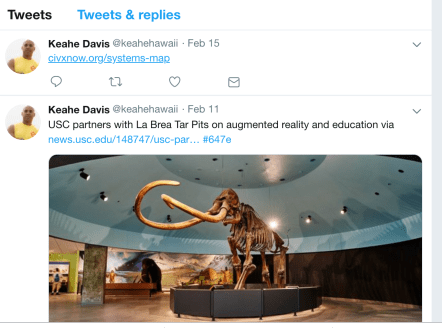
What I can see is that most of us evolve over time, become more discriminating about tweets and create more robust retweets that provide a few words about why you are retweeting. Keahe’s @keahehawaii are highly evolved with his latest posts being very relevant to his scholarship and locus of control.

Screen Shot 2019-05-09 at 7.54.04 PM

Every grad student (and all their instructors) need to have active Twitter accounts. It is an extremely prolific source for diverse resources and viewpoints on … everything, and without one you are living in Plato’s cave. Yes, I love Twitter.

Continue reading “Blog Post Week 6 (Twitter Experience)”

Blog Post 5 Twitter N Me

I signed up for a Twitter account in 2010 at the annual PCATT conference at Honolulu Community College. I was fascinated during the panel discussion as attendees were tweeting comments and questions live to the group, and panelists were responding to them. When I went to lunch, Bert Lum (Burt Lum @Bytemarks) and Jonathan Wong @jonathanwspeaks said, “you gotta have a twitter account!” and walked me through signing up for an account.

Since then, I have used Twitter almost daily as my personal learning network. I follow many different kinds of people and groups, and it has been an invaluable way to see what is trending or follow a topic I am interested in, be it educational, political, social, anything that I want to know more about.

Almost every instructor I have had in LTEC has a twitter account, and Dr. Bert is one of those who uses and teaches it in his classes. I have heard every excuse in the book from my friends who do not have Twitter accounts, so they really never experience the value of it. I am frustrated when I take a course if the teacher does not have a twitter account since it is an invaluable way to share quickly.

A big factor is controlling your twitter feed to filter the posts you want to see. I like the limit on the number of characters although now that it is doubled from 140, it feels like there is no limit. It forces the writer to choose carefully, and it allows the viewer to quickly see whether you want to pursue the information on the post.

Twitter has actually fueled overthrows and massive political movements. Getting news as it happens from many different sources is far more valuable than reading it in the one paper in town.

At the recent state STEM conference, (#HISTEM) we converged on a colleague from Molokai to start a Twitter account. I said it would change his life, and he was amazed at what happened just in the first hour of opening an account. We can now share valuable information about CoSpaces and Merge Cube to as many people as we want, quickly, without resorting to the protocols involved in email or even FaceBook.

Since all your tweets and replies are saved in your feed, I am able to find earlier posts I want to go back to. An example is https://jonathanwylie.com/2018/06/18/green-screen-tips-from-teachers-on-twitter/

Green Screen Tips for teachers on twitter (Leilani, this one’s for you).

Blog Post Week 10 (Mid-semester Evaluation)

I am not sure whether this post will be useful to anyone since it comes so late in the course ;-(. Nonetheless, I would like to share some thoughts as we finish the course. I always start each semester with great anticipation, raring to go. Then somewhere along the way, life seems to get in the way. This semester was no different, and it is always a wrenching decision what to give up from my plate at each point since I am just not capable of doing it all!

It seems I have given up on blog posts for the course. While these can be a strong personal development of ideas throughout the course, I don’t really see them as a critical part of my learning in the class. They are not necessarily user-friendly, as it took a while for all of us to figure out how to write and post them. I guess the bottom line is that a lot of work actually goes in to the writing, and it is not viewed by many. Perhaps more use of the discussion board would be a better place to write. I also do not like to have my posts public, but it is too much trouble to password protect.

Case studies have kept my head above water in this class. They definitely promote collaboration, creativity, communication, and critical thinking. I was fortunate to be in a group of strangers turned friends, all who entered with great respect and humility, very different backgrounds, and a love for learning. So we came in already at the “point of productivity” where we struggled with the concept of the case study and were able to create one. As confusing as these seemed to be initially, they definitely provided an anchor in the class that kept me engaged.

I appreciate the use of LINE as a means of communication, even though I do not heavily use it. Fortunately, my group mates were willing to share their phone numbers, which made it much easier to communicate when needing speed and short answers. Zoom was also helpful; while I have a room, it turned out to be fine to use Dr. Bert’s room without running into other groups ;-).

Finally, the content of the course and resources and facilitation provided by Dr. Bert has met and gone beyond all my expectations. Technology changes so rapidly I feel this should be ongoing for all LTEC students, or at least repeated every two to three years. All of the topics are critical for all of us as users of technology, and even more so if we are instructional designers and educators. Mahalo!


Blog Post 13 – TCC 2019: Expectations

It was exciting to see how the wide range of topics listed in the call for presentations has grown this year. Most of these are truly critical issues in my locus of control, my workplace, and my wider community.

The idea of “designing for cultural differences in diverse contexts rather than designing around them” intrigues me, especially as I work in a K12 setting in which the lack of design for cultural differences seems to be our blind spot, evidenced in the low success of kanaka maoli students over the last three decades.

Intercultural communication and competency; connectivism and connected learning; distance learning communities of practice; building and sustaining communities of learners; and enabling student collaboration, creativity, and advocacy for learners of all ages continue to drive my interest in instructional design.

TCC is one place where I can view research on emerging technologies, especially AR, VR, flipped learning, AI, robotics, and their relationship to ethics and social issues in online learning. It is always exciting to see my favorite presenter, Lyr Lobo!

So once again, I am looking forward to the conference and expect to gain a lot of food for thought.

Blog 3 Real collaboration is a joy!

This team worked very well together. We found times to meet and discuss the project on Zoom, and then everyone worked on the project in between as we had time.  Each one of us came forward to contribute in our areas of strength, and as the project progressed, it was clear that collectively we had serendipitously found a team that worked!

I appreciated that the meeting times on Zoom were focused, productive, and professional. The tone in the group was friendly and supportive. I felt everyone was comfortable to express their thoughts and ask questions.  I thought we would have to meet more often; what I found was that once everyone clearly understood what we needed to do in our initial meeting, everyone just jumped in and worked whenever they could. It was a relief to find that others were good at graphics, proofreading, checking links, and everything else needed to complete the case study. I cannot really think of anything that did not work well. We are all busy so working asynchronously as needed allowed us to keep moving ahead.

The best way to communicate concerns would be to keep the focus on the project, and not on individual performance. It is also important to maintain our spirit of aloha. Mahalo nui loa to Leilani, Bryan and Kahealani; imua kākou!

Blog 2 What happened?

blogweek2

These first two weeks of class have actually been exciting

  • The  class is made up of diverse humans who are creative thinkers, willing collaborators, and kind; I feel comfortable here
  • The New Media Consortium Horizon Report 2018 is the one piece that was the most useful
    • Since it provided both textual and graphic representation of its content
    • Since it will act as a guide for this “emerging technologies” class
    • Since it is comprehensive
  • I would like to learn more about connectivism because
    • I want to see if it works in learning spaces like our class
    • I like the theory
  • I would also like to learn more about interdisciplinary initiatives
    • Because they reflect how the real world functions
    • They reflect the world in which my students will need to live, learn, and work
  • What new technology and concepts did I learn this week?
    • I actually spent a lot of time exploring Artificial Intelligence
      • In the case study proposal
      • At the IEEE Summit on Communications Futures on January 19
  • How can the week’s activities be strengthened?
    • Directions and time tips given for groupwork on case studies
    • Comments on initial case studies posted the day before class. Or, the day of class, do presentations and give team time to revise, which is what we are doing.
    • More examples of case studies – maybe reviewing one in small groups during class time, then reconvening to calibrate our understanding of the assignment
    • More campfire time (Thornberg)
      • There were a lot of tasks to accomplish and not enough time to explore in depth and
      • create quality products
      • unless, of course, this is the only food on your plate 😉
      • realizing this may not be considered substantive for lack of narrative, but this is to your advantage, trust me.
  • What new insights and problem solving strategies did I realize during discussions or while working with others?
    • I am not sure I will be able to manage my time this semester so looking for organizational tool without loading yet another app
    • It is fun being with my group and the class; I love to be with others who also love to learn.
    • I need to strengthen my design skills

Blog 1 Why am I creating yet another blog?

why-1780726_1280

Aloha mai kākou! Welcome!

Why am creating yet another blog?

  • To share reflections with all of you in the class
    • Reflections that expand and extend what we have done in class for the week
    • Reflections that did not “fit” in the assignments and need a home before they are forgotten
  • To try and inspire you to respond to me with the same
    • Help me expand my thinking
    • Help me grow my mindset
  • To create a weekly history
    • Of my learning in this course
    • To show growth and possibly even an impact on my teaching practices